

I’m seeking shelter from this spring’s first Meltemi in the harbor of Ikaria when the phone rings: do I have time to sail a boat from Tenerife to Galicia this spring? I know the boat, a beautiful blue aluminum Koopmans 40, and its owners Marcel and Anne from a distance, because we left the Netherlands around the same time. A quick glance at my calendar tells me I have five weeks open, starting at the end of June. Before I can overthink things, we’ve agreed that I will take on this ocean adventure.
Preparations
While skippering in Greece, I spend my all my siestas and evenings planning the trip. Once my guests have gone home and the boat is tied up safely to a mooring buoy, I board a plane to Tenerife, where I shake Marcel’s hand for the first time. He shares the same love (or madness) for beautiful and solid boats, and turns out to be a very amiable and interesting person.
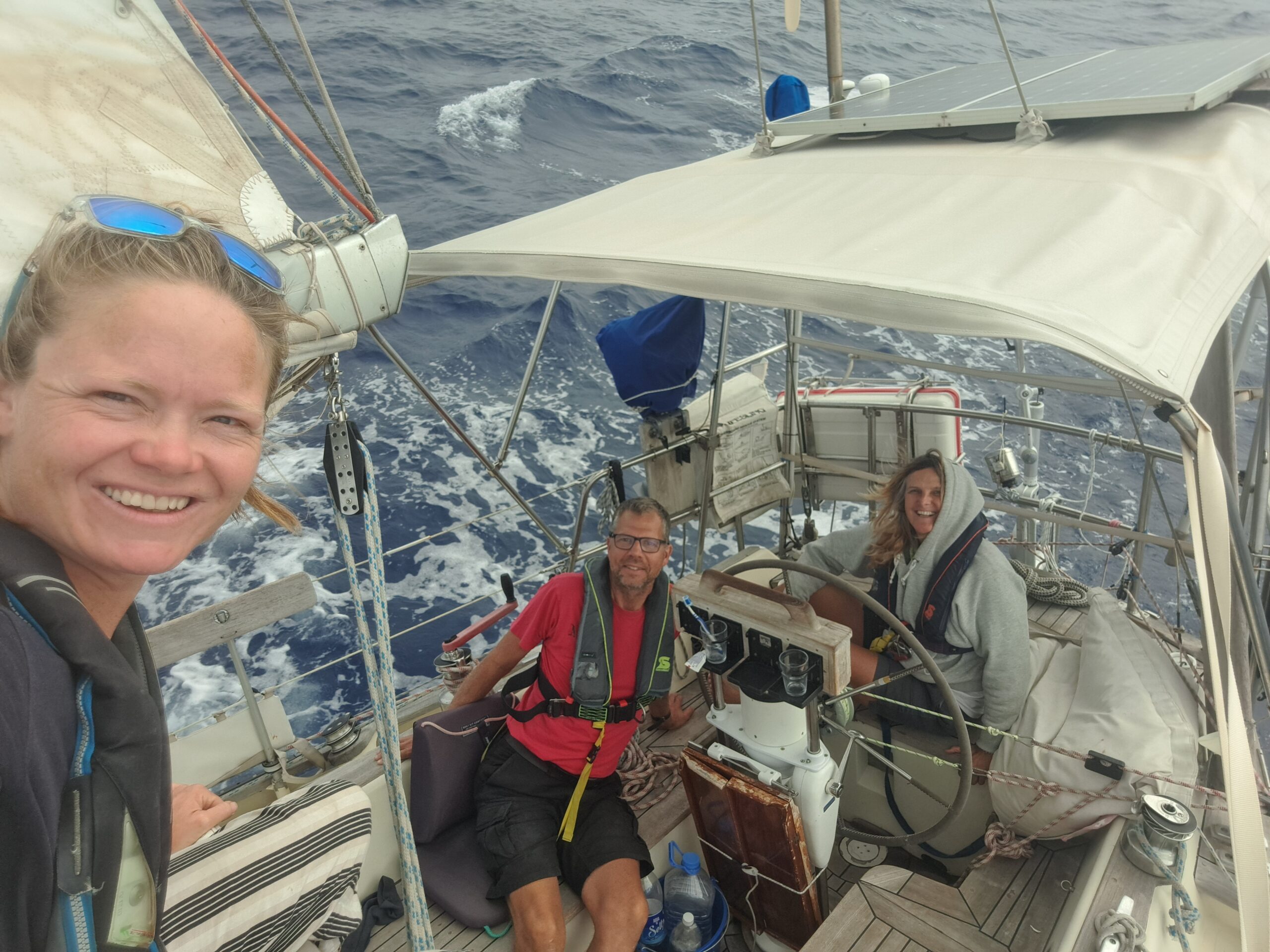
I will not be sailing ‘Zeezot’ to Galicia by myself: to my great delight, Nicola and Jonas, two solo sailor friends, have agreed to join me. Nicola is the first to embark. I know few people who embrace the sailing life as wholeheartedly as she does, and her cheerful disposition, determination, reliability, and conversational nature make her my ideal co-skipper.
The three of us do a thorough check of Zeezot and her systems. Engine, sails, standing and running rigging, wiring, valves, spare parts, and crucial tools: inevitably, a technical problem will arise sooner or later, and we have to be able to solve it on the open sea. Fortunately, the boat is not only well-built but well-maintained, and the equipment we need for a lengthy passage like this is already on board.

Next step is provisioning at Lidl. Since I lack any talent for grocery shopping, Nicola’s pragmatism is a godsend. How much do three hungry sailors eat on a voyage of over two weeks? No one knows exactly, but we find the right balance between long-lasting and fresh, simple and nutritious, varied and delicious.

With the boat and groceries ready, it’s time to study the weather forecast. With a strong headwind and a complete calm halfway through, it’s not a promising prospect. We consult with my brother and shore-based navigator Douwe, and with a few other experienced sailor friends. Ultimately, everyone agrees: leave as soon as possible, waiting will only make things worse
Ready for departure
On Wednesday, Marcel leaves his boat in our care and board his four-hour flight to Galicia. A few hours later, we welcome Jonas. He seamlessly completes our trio of solo sailors: equally enthralled with the sailing life, equally partial to solid boats, and equally appreciative of the simplicity at sea. A solid personality, reliable, empathetic, witty, and devoid of a large ego: ideal qualities for my other co-skipper. With his arrival, we’re ready to go.

That night I sleep restlessly, fretting over things I’m afraid I’ll overlook. At 3 a.m., I wake with a start. It’s warm in my cabin, and I can faintly smell the sour, sulfurous fumes of a boiled battery. I turn off the charging current and open the battery box. It’s warm, the battery is bulging, and the voltmeter reads a pitiful 11 volts. Apparently, there’s nothing wrong with my sense of smell.
The next morning, I contact Marcel, and together we solve the battery problem in no time. Nicola takes the bus to the nearest village, where Marcel has had a new battery prepared. Before breakfast, the voltmeter reads 13 volts, even without the charging current. After a final hot shower and a thorough safety check, we’re ready to go, with the first hurdle behind us. An excellent start!

Around noon, we start the engine and cast off. The harbor entrance is narrow and bumpy, but Zeezot steams along nicely. Up goes the sail, down goes the centerboard: we’re sailing! To ease into the rhythm of the sea, we add a second reef, still a bit clumsy with the reefing system on the mast. We’ll get the hang of it soon enough… The peak of El Teide is towering above the clouds, as if waving us goodbye.

Behind Madeira
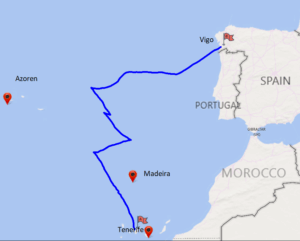
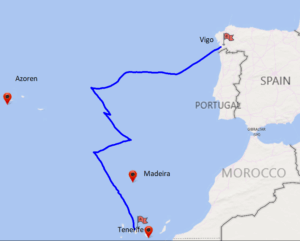
For two and a half days, we sail as close to North as possible, on a course of about 320 degrees. There’s nothing but sea all the way to the horizon, but on day three, around noon, the wind suddenly dies down. Almost simultaneously, the satellite phone beeps: “You’re entering the wake of Madeira.” Douwe is clearly watching us closely, and the Grib files that map the lee behind Madeira appear to be quite accurate. It’s incredible that, at a distance of at least 50 miles, the influence of that small rock in the sea is still so noticeable.

The wind soon picks up again, and the sea is building quickly. Longer and slower than in Greece, because the ocean is immeasurably deeper and wider than the Mediterranean. A great blue mass lifts Zeezot and, with a gentle mother’s hand, lets her slide back down into the trough. Well most of the time at least, because every now and then Zeezot loses its inimitable ocean rhythm, and a wave crest thunders and crashes against her metal bow: “Klabám!”: the anchor, lashed to the roller, has some sideways slack, and while that’s harmless, it does make a lot of noise.
I repeatedly go forward to see how I can reduce the noise, but there’s not much I can do on the bucking foredeck. We’ll have to get used to it.
Yankee down
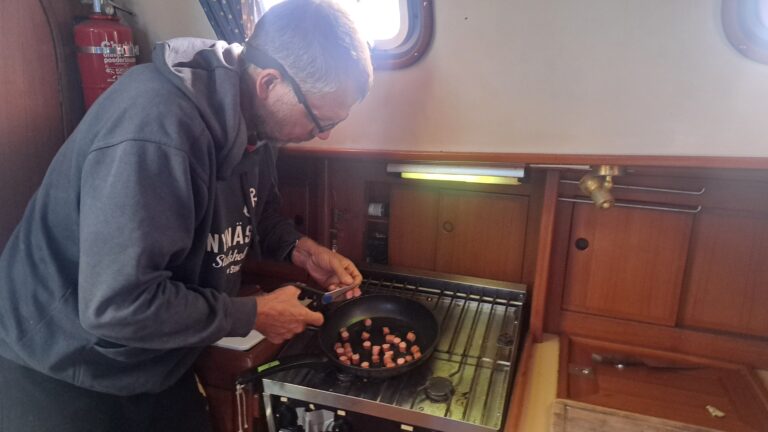
When the evening falls after the sixth day at sea, Nicola takes over my watch, and it’s Jonas’ turn to cook. Zeezot pitches and struggles northeast across an increasingly rough sea, and to make things easier for ourselves, I consider swapping the Yankee for the jib. Cooking on board is becoming increasingly challenging, especially now that we’re sailing on starboard and the galley is therefore located on the high side. Vegetables have the unstoppable tendency to end up on the floor while being cut, pans stubbornly slide off the fire despite the gimbal stove, and the basic skill of pouring something in a cup requires a precise calculation of the correct angle. Add to that the fact that we’re ourselves continuously being tossed around, and you understand that preparing an evening meal requires quite a bit of acrobatic culinary skill.
On the other hand, it would be a shame to reduce, sail because we’re making a good five knots in the right direction. To break through the swell properly, we need that speed. With too little sail, the progress will be too slow, and it’s still a good thousand miles to Galicia. It’s balancing comfort with performance, and I can’t make up my mind.
“Kla-PANG!”: the next big wave crashes with a slightly different sound, and Nicola and I frown at each other. Behind the mainsail, we suddenly hear the yankee flapping. In two seconds, I’m lashed to the deck: the halyard has come off, and the sail is slowly coming down. I gesture to Jonas, who has paused his cooking for the occasion, to furl the yankee, and in no time at all, the sail is safely and tightly on the furling profile. Meanwhile, Nicola unfurls the jib, so that a little later we can continue sailing northeast a little slower, but much more comfortably. It’s like we’ve been sailing together for years! As a bonus, I’m instantly relieved of my indecisiveness.

Flying visit
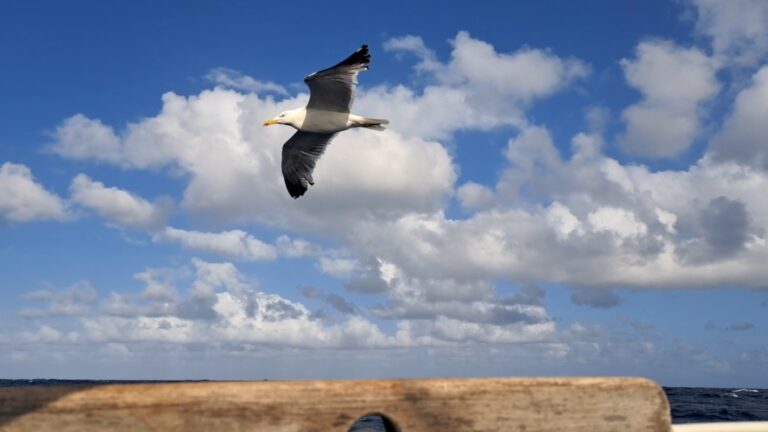
A seagull glides along with us for a while, seemingly unhindered by the strong headwinds. Its wing trim is perfect and refined; even Zeezot flaps more than he does. The four of us (including Zeezot) are hoping it will land on the bimini, but after a few hesitant attempts, it doesn’t dare. We feed it some crackers, since we have nothing better to offer. You wonder what such a creature is doing here all alone, so far offshore, between Madeira and the Azores. But then again, that’s probably exactly what he’s wondering about us.
Defeat
I wake up with the first rays of sunlight. Coffee first, so I stumble into my clothes and cling to the cabin steps while I’m grinding coffee beans. A large wave tilts Zeezot, so that the contents of my full mug disappear into the bilge. Mopping is an adventure in itself, but not much later I settle in next to Jonas in the cockpit with a fresh cup of coffee, to get the latest weather reports via Iridium. Over the past few days, we’ve been struggling to steer a depressingly slow course of 320 degrees, pinning our hopes on a weather window that, with three full days of northwesterly winds, should take us well in the right direction. The new reports are disappointing: our weather window has virtually disappeared from the forecast. Instead, the wind continues to blow from the north, and will bring us a strong northeasterly wind on the nose later this week.
As I ponder the implications, the wind shifts and our course changes to a sad 310 degrees, 300 degrees, 290… Now we’re sailing more west than north, while our chance of sailing smoothly east has vanished. I peer at the plotter, which helpfully shows we’re heading for the Alaskan coast.
As soon as Nicola gets up, I discuss the forecast with her and quickly make a decision: there’s no point in sailing west if we really want to go northeast. We’re almost halfway through our water supply, have been making a meagre three and a half knots for the last few days, and it’s still at least 800 miles to our intended destination. Based on that, the northern coast of Galicia isn’t realistic, and we’d be better off heading for the west coast of the Iberian Peninsula.
As a drizzly shower rolls in, we tack, hoping to sail due east. But the course on the new tack is a disappointing 100 degrees: now the plotter is showing us heading for Morocco. With careful trimming, adjusting the wind pilot, and carefully summoning all of my patience (admittedly, it’s very little), we wait in vain to see if the course improves. Shore-based navigator Douwe texts us: “Current course entire area waves >3m, wind 26kts, gusts 35kts”.
Not much later Jonas spots a pod of spotted dolphins. They are determinately swimming northwest, taking little time to interfere with Zeezot, although they do come back once or twice as if to herd us in the right direction. This is the final push: we accept defeat and tack again. With a long swell and a newly trimmed sail, we follow the dolphins at a good five knots on our old course of 320 degrees.
Sense of time
Now that we’ve resigned to the wind forcing us further northwest, the rhythm of the sea takes over from the rhythm of day and night. The watch schedule divides the days into 9-hour cycles: 3 hours on, 6 hours off. The schedule repeats itself every three days. The best days are those where you stand watch from 9pm to midnight, so that after a spectacular sunset, you can try to sleep from midnight until dawn, like a normal person. In the morning, you’ll see the sun rise above the sea in all its glory.

Bad days are those where you have to be out at 3 a.m., only to sleep from 6 to 12, just when you’re ready for coffee. As if that weren’t enough, you also have galley duty on those evenings, which is a serious challenge on a pitching and heeling ship -for most of us, at least. If you’re lucky, the sky is clear, and a dazzling starry sky offers consolation, while the sea glows with phosphorescence. There’s a silver lining to everything.
Yet it’s no longer dusk and dawn that mark the days, but the pages in our logbook: each day is a page, each page has 12 lines, one for each watch, plus a few extra for special occasions. Outside the logbook, the date has lost all meaning. The days string together seamlessly, merging into a rolling mass of time. Our biorhythms also adapt, transforming us into hibernating bears, living in ¾ waltz rhythm of sleeping – eating – watching the sea.

Yankee up
When the wind finally drops to 15 knots after no-one-knows-how-many days of struggling upwind, it’s time to hoist the yankee again. I’m grateful to Marcel for the spare halyards in the mast, because climbing the mast on a rolling ship is a bit too much even if you love climbing. We prepare everything thoroughly, heave to with jib and mainsail, and have the yankee down and up again in no time. Nicola handles the sheets at the helm, while I make sure the headsail line slides neatly in and out of the profile. Jonas is working at the mast, winching the sail up. Zeezot responds immediately by speeding up 1.5 knots. Excellent teamwork!

Sleep
In an attempt to sleep, I’m startled awake by a foaming wave crashing against Zeezot’s bow. In the cabin’s soundboard, it sounds as if Poseidon himself has struck us off the face of the earth with his trident, and because I was dreaming about freak waves, all the alarm bells go off. Outside, I see Nicola (or Jonas; this scenario repeats itself several times) sitting in the cockpit, calmly monitoring the situation. I can’t resist a quick chat: does the world still exist, are we still sailing above water, is the mast still standing? And what’s the speed, course, and wind? And also: tea? “Anne, go to bed,” is usually the reassuring answer.
Sleeping—just like all other basic tasks, like making coffee, getting dressed and using the toilet—isn’t so easy. Fortunately, Zeezot isn’t a catamaran and is therefore constantly heeling over to one side. That’s why it’s best to sleep on the lower side of the boat. Gravity will then push you against the wall, but that’s still better than the high side, where you’ll be floundering like an unhappy fish in the net that serves as a lee cloth. The aft cabin has a comfortable wall when sailing on the starboard side, but the first aid kits stowed there tend to nestle against you rather intrusively. On the port side, those same kits create an uncomfortable berth, so it’s better to sleep athwartships—although that also has its complications if you’re over 1.80m tall. To give everyone as much sleep as possible, we’re rotating our sleeping arrangements. My bed is your bed; there’s little room for privacy on board.
The seething sea
With the Yankee back in the game, we’re finally making a good five knots again. The wind is encouraging us by backing to the northwest, so we can sail a nice northerly course around the Costa del Muerte. Galicia suddenly feels a lot closer. “And now, the end is near …” Jonas basses, and Nico and I join in wholeheartedly.
But an epic isn’t epic without an arc of suspense. So, three-quarters of the way through the story, a setback is expected, shattering the hopeful mood. Aeolus, who apparently loves an epic ending, sends another strong northeasterly wind our way. The grib files show 30 knots and 3.5-meter waves. I finally give up hope of sailing around the Costa del Muerte and set my sights on the Rias Baixas. I don’t dare count on it, but the weather reports whisper of a gentle breeze from the southwest once the strongest wind has passed.
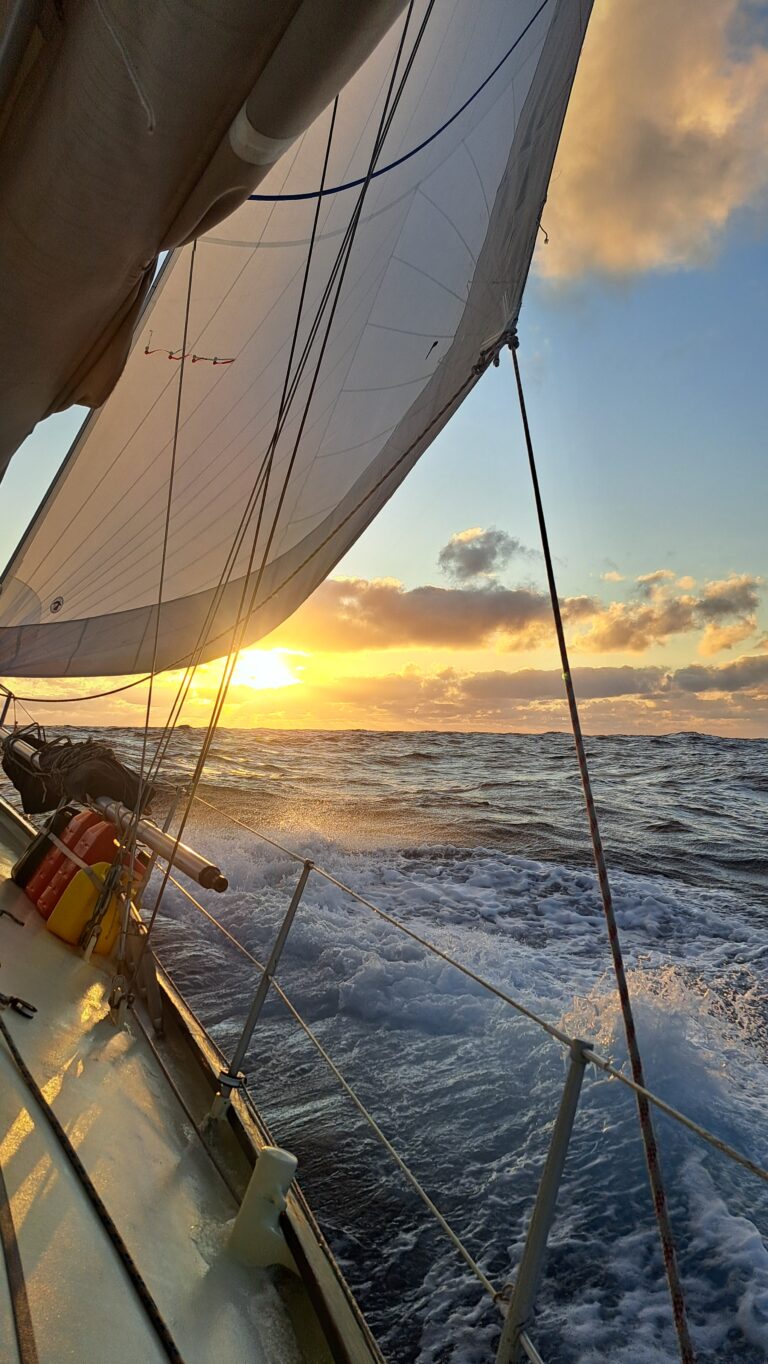
To avoid the dark red area in the grib, we decide not to tack or bear away, but to slow down. We set the third reef and the jib, and sail as closely hauled as possible. Our speed drops to 3.5 knots, but the calmer movement on the rough sea gives us a good night’s sleep. This way, we let the bad weather pass in front of us, just as we would a fast-moving oil tanker.
It’s a good thing we’re well settled in by now and no longer fazed by gusts or surging waves. We knew beforehand that Zeezot is a strong ship, but it’s now proven in practice, and we confidently sail towards wind force 7. No storm, nothing to worry about, just a vigorous pounding against the wind. In the cabin, the interior creaks, rumbles, and vibrates, but in the cockpit during the watch, there’s not much going on. Zeezot bravely steers herself forward under reefed sail, and we watch as she slowly dances through the landscape of salt water hills. During my watch, I prefer to stand upright on the cockpit bench, one hand on the hardtop to steady myself, while salt spray and sea foam whirl around my ears. The violence of wind and water is overwhelming, but I’m most impressed by how the boat still steadily maintains her course. I feel insignificant in this landscape of oncoming water, but simultaneously safe and secure in the knowledge that I can rely completely on the boat and crew. I’m constantly alert, but never afraid. That immense trust in the boat and crew is a great gift, and I feel it more strongly now than ever.
The joys of a flat sea
Exactly as planned, the wind finally drops to less than 15 knots overnight, for the first time in two breezy weeks. Little by little, we set more sail until we reach ‘full all’, while the swell subsides. The autopilot takes over: a wind pilot needs wind, and it has suddenly, miraculously, disappeared completely. It’s time to start the engine.
It’s humid and cloudy outside, as if someone has draped a clammy blanket over the world. Nevertheless, we open the hatches to air out the stuffy spaces below deck. We sweep the cabin, rearrange the refrigerator, and hang out the musty towels. A hesitant breeze slowly picks up from the south, which we hardly recognize because anything below 20 knots now feels like a dead calm. But when we cut the engine for a quick engine check, we discover, to our great delight, that the wind can bring us straight to Vigo.

Without spilling anything, I hand Nicola two full mugs of coffee at once, and after lying on my back on the foredeck for a while, gazing at the beauty of two billowing headsails, I take a nap on the high side of the cabin. The sound of churning, pounding, and crashing water has given way to a soft metallic rippling and lapping: music even J.S. Bach can’t match. Zeezot is in her element; in full regalia, with all sails set, she glides calmly, gracefully, and elegantly through the waves, like a horse that’s been allowed in the pasture after a long day’s hard work. Meanwhile, Jonas has burst into spring songs, as if to force the sun to break through the clouds. Sailing like it’s a holiday cruise: we’ve all been looking forward to it.

Welcoming committee
One more danger is lurking during the final leg of the journey. For several years now, a few bored orcas have been swimming along this coast, developing a hobby of ramming passing sailboats against their rudders. Countless boats have been crippled in recent years, suffering severe damage to their rudders, or worse. The images of these attacks circulating online are impressive and fascinating, but we’d rather not witness them firsthand.
The evening before arrival, we slow down a bit so we can start our approach in daylight. We bring the windpilot inboard, the autopilot has stopped working on its own account, as a precaution to prevent damage in the event of an attack. So we steer manually and are extra alert for large black fins. Fortunately, there’s a brilliant full moon, so we can at least see who we’re dealing with in case of an attack.

Ominous black fins repeatedly appear in the silvery moonlight, but thankfully, the rudder blade remains untouched. They were probably dolphins, but when you’re thinking about Orca’s, everyy dark triangle looks like one. In the morning, as the moon changes watch with the sun, just as I’m changing watch with Nicola, I see six fins swimming towards Zeezot. My heart leaps… with joy, because they’re dolphins, and it’s beyond doubt that they’ll accompany us, like a welcoming committee. I don’t have any evidence, but I’m certain the orcas will stay away as long as we’re flanked by dolphins.

Nicola takes over, and I move to the bow, surrounded by dolphins, to try and swallow the lump in my throat. In the early morning light, hills loom, an island, and then a city… I should be happy and relieved, perhaps even proud, but instead, melancholy (weemoed) grips me. I wave goodbye to the fading moon, which disappears with the rising sun. “Can’t I come with you?” I ask my dolphins, because however turbulent the journey was, the simplicity and rhythm of life at sea have created a silence in my mind that can’t thrive in a city. Boat life forces simplicity, limits your vision to the bare essentials. Boat and crew become one, caring for each other, keeping each other safe. Without us, the boat wouldn’t sail, without the boat, we’re going nowhere, and I would never have dared to attempt this crossing on my own. In total isolation from the rest of the world, this creates a connection that touches me, and a relationship with the elements surrounding us that I’m not ready to give up yet.
As salty tears stream down my salty cheeks, the antics of my comfort dolphins make me laugh, and I realize that this arrival to land is also a farewell to the sea, and that is why I am crying when I should actually be laughing.
Vigo
Almost exactly sixteen days after our departure, we sail into the port of Vigo. We retrieve the fenders and mooring lines from the forepeak, and I slowly steer Zeezot alongside the dock. Jonas and Nicola dismount and tie up: two lines forward, two lines aft, we’re docked! A bit unsteady on my sea legs, I jump on land and embrace my indestructible, steadfast, cheerful and indispensable crew. Very happy, relieved, and perhaps even a bit proud of what we’ve accomplished.

Wow 😮
What a great story and achievement by you 3 guys!
I’m so impressed that I lack words!
Your way of using words Anne, is so fascinating that I can feel, see and understand your adventure…so impressive ❤️❤️❤️